I had a few CDs cross my desk that were recorded by a San Diego new music collective called Trummerflora. Their name sounded interesting, but I didn’t think another thing about it. Then in the booklet of one of the discs I read its definition:
Trummerflora, or rubble plants and trees, are a special phenomenon unique to heavily bombed urban areas. The bomb acts as a plow, mixing rubble fragments with the earth, which often contain seeds dormant for a century or more. These seeds come to light and those that can live in this new and special earth grow and flourish.
–Helen and Newton Harrison
So something beautiful comes to light through acts of unspeakable destruction. Suddenly I though that it was an amazing word and a concept that holds out some hope that something good can come out of the worst of situations. Of course, this is a particularly tainted kind of goodness, a sort of goodness that you accept because the alternative is so much worse.
Trawling around the web as I write this I couldn’t find other references to this word other than in the context of the musicians or the quote from the Harrisons. Did the Harrisons coin the word? (Of course, just becuase search engines don’t turn up something, it doesn’t mean it doesn’t exist! (Or in this increasingly virtual word, maybe that’s exatly what it means?)) Or did the word spring to life–maybe in Germany?–after the devastation of World War II?

Helen and Newton Harrison. Breathing Space for the Sava River, Yugoslavia, 1988 (detail). Photocollage, text, maps. [ source ]
This whole notion of bringing life back to wastelands has been one of the major themes of Helen Mayer Harrison and Newton Harrison, the artists responsible for the quote in the first place. As a couple they taught at the University of California, San Diego from 1969-1993, and during this time I had the chance to see several of their exhibitions around town. Here’s a description of their working method in Barbara Matilsky’s 1992 book, Fragile ecologies: Contemporary artist’s interpretations and solutions, quoted on a Green Museum page.
After firsthand study, research and interviews with ecologists, biologists and planners the artists create a photographic narrative that identifies the problem, questions the system of beliefs that allow the condition to develop and proposes initiatives to counter environmental damage. They exhibit their documentation in a public forum–a museum, library, city hall–to stimulate discussion, debate, and media attention. By communication to the public the problems that confront a fragile ecosystem and the ways in which the balance can be restored, they exert pressure on the political system and rally public opinion in an attempt to avert ecological disaster.
So, while the Newtons would be pleased to see trommerflora grow and thrive, their greater satisfaction wouldn’t be achieved until we come to an understanding of the systems that brought about the original destruction. And if the projects became so successful that they’d annihilate the need for its the artwork’s own existence? I doubt the Newtons would mind, but I won’t be holding my breath that we get there anytime soon.
Read further: The Newtons in their own words.


 I’ve said a couple unkind words against the mounstrously vigorous Mr. Stripey, but that’s the variety that bore first this year. The fruits so far have been small, about three ounces, sweet and extremely mild, with a very thin skin. The color is a rich, medium yellow, with dark rosy-red flushing to the fruits both inside and out. So far they don’t gush classic tomato flavor, but they’re still the best tomatoes I’ve had since last autumn’s farmer’s markets.


 When I take my lunch break during the week and head to the gym, I follow a path that takes me by a small cluster of eucalyptus trees planted in a patch of lawn. Several of the trees have beautifully smooth trunks which are covered with a delicately mottled silvery bark. Once a year, usually late in spring or early in summer, the bark exfoliates, dropping off in small chunks that reveal the surprise: a bumpy, pale ocher layer of new bark underneath.
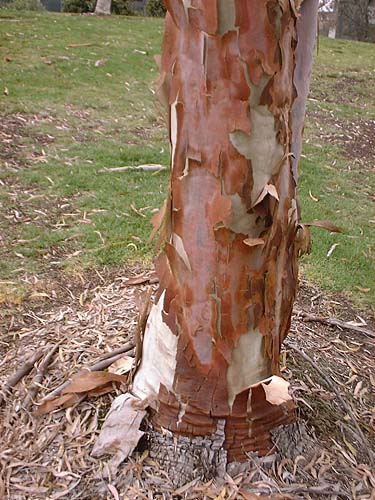 Another of the trees drops larger, thin, brittle sheets of red-brown bark, revealing a deliciously pale icy green below.
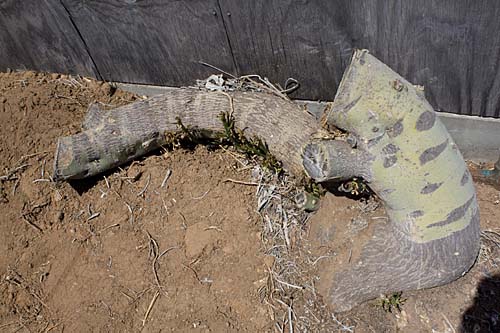
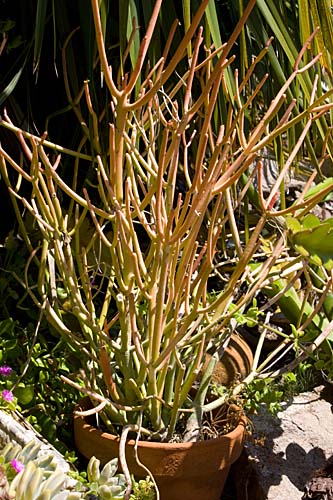 Halfway across the yard, in a little clay pot, sits another variant of this species, the red form that’s been given the clonal name ‘Rosea,’ and is commonly known as “sticks of fire.” It’s supposed to be a lot less vigorous. It’s not supposed to get much over six feet tall. It’s supposed to lack the same amount of chlorophyll and have less of that life force than its green big brother. But I’m skeptical. That plant isn’t going to get to live outside of its pot. Ever.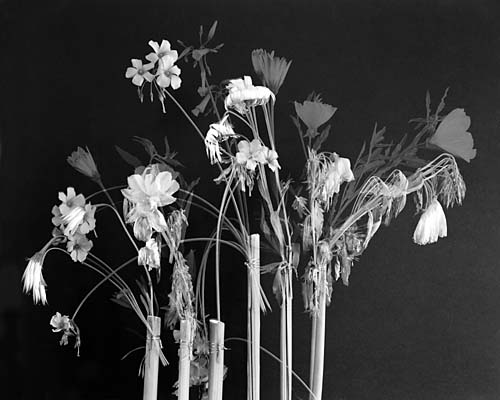
 As you might guess from the title, it’s almost exclusively photos of plants in vases where the flowers have been cropped out of the picture. It’s a little willful, for sure, but I think many of the images are really beautiful. See what you think…